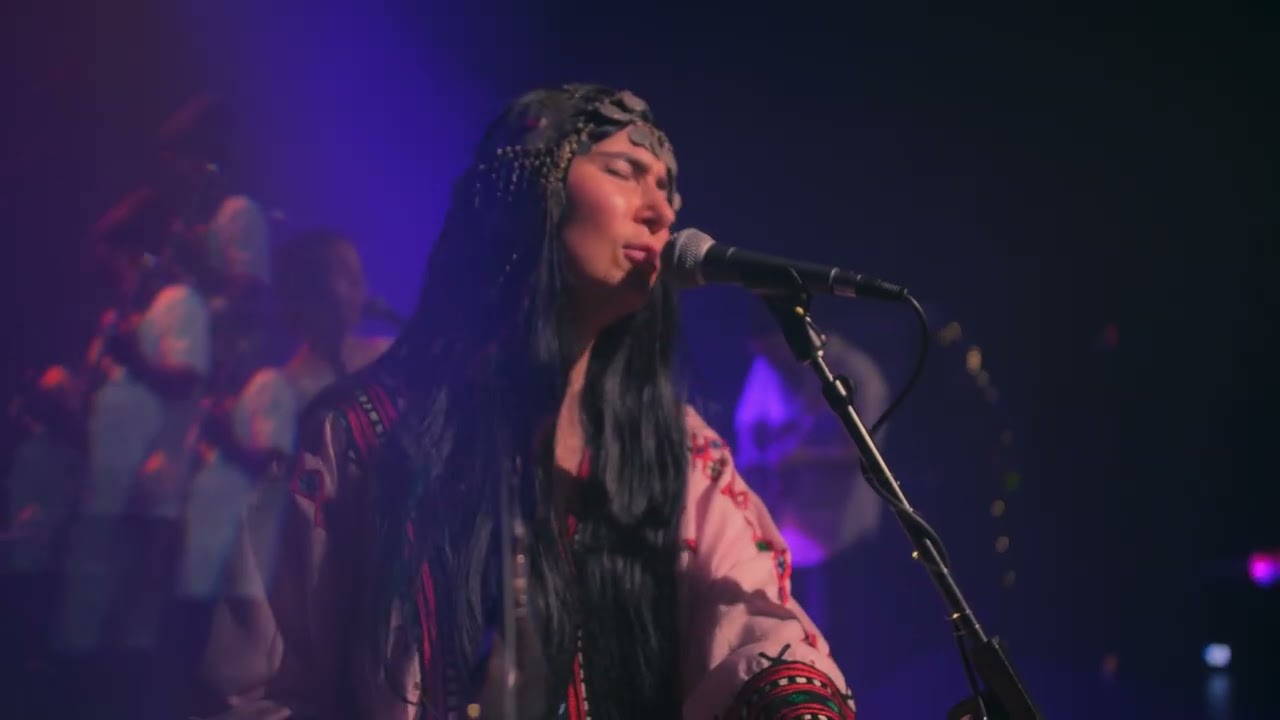
"Salók" is a live performance by vocalist and harmonium player Simrit and West African kora master Salif Bamakora, filmed at Life Force Academy in Nevada City, California. The piece demonstrates how two distinct musical traditions—Indian kirtan and West African griot music—can merge through shared devotional intent, call-and-response structures, and the use of acoustic instruments to invoke sacred presence. The performance uses minimal lyrical repetition (phrases like "good," "God," "mother") layered over intricate kora melodies and Simrit's vocal harmonies, creating a meditative soundscape that privileges texture and emotional resonance over narrative or formal song structure.
What Is "Salók" and How Do These Traditions Meet?
"Salók" exists at the intersection of two ancient musical lineages. The kora—a West African harp-lute with 21 strings, traditionally played by griots (hereditary historians and musicians of Mandinka culture)—brings centuries of oral tradition, complex fingering patterns, and a tonal richness that sits somewhere between plucked strings and a full orchestra. Kirtan, the Sanskrit-derived call-and-response singing practice rooted in Hindu and Sikh devotional music, emphasizes repetition, collective participation, and the invocation of divine names or qualities.
When Simrit layers her voice and harmonium over Salif Bamakora's kora, she is not attempting a fusion genre in the Western sense. Instead, the performance reveals that both traditions share fundamental DNA: they are rooted in oral transmission, they use the human voice and acoustic instruments to connect with something transcendent, and they rely on cyclical, repetitive structures to deepen attention rather than advance a linear story. The kora's cascading arpeggios provide a harmonic foundation that allows Simrit's voice to float, land, and spiral without needing conventional verses or choruses.
How Does Minimal Lyrical Content Create Depth?
One striking feature of "Salók" is its textual simplicity. Listeners hear phrases like "good," "God," "mother God," "give," and "know"—words that appear and disappear, sometimes half-sung, sometimes nearly whispered. This is not a limitation but a deliberate aesthetic choice rooted in both traditions. In kirtan, the repetition of a name (like "Ram" or "Om") is believed to attune the nervous system and mind to a particular frequency or state. The word is the vehicle, not the destination.
In West African griot music, melodic and rhythmic patterns often carry as much meaning as words; the kora can "speak" through its tonal variations and call-and-response with the voice. By paring down the lyrical content, "Salók" invites listeners into a space where meaning shifts from conceptual understanding to somatic, felt experience. The repetition of "good" or "God" becomes a kind of sonic mantra—a anchor point while the instruments weave elaborate patterns around it. This approach asks the listener to stop decoding and start receiving.
What Is the Role of Call-and-Response in the Performance?
Both kirtan and griot music depend on a dialogical structure: the leader calls, the group (or in this case, the second instrument) responds. In "Salók," Simrit's vocal lines often emerge from or resolve into the kora's melodic figures. When she sings a phrase, the kora seems to answer, elaborate, or echo it, creating a conversation between two voices rather than a hierarchical lead-and-backup arrangement.
This call-and-response is not always obvious or literal. Sometimes the kora moves in counter-rhythm to the voice, creating a kind of polyphonic weaving. The back-and-forth generates a sense of intimacy and mutual listening. Neither instrument dominates; instead, they create what might be called a "sonic embrace." For listeners, this structure activates the same neural pathways that call-and-response does in a group kirtan: there is an implied participatory space, even if one is sitting alone listening to a recording. The listener's ear becomes the respondent, tracking and anticipating where the next phrase will land.
How Does the Harmonium Support the Kora's Harmonic World?
The harmonium—a keyboard pump organ central to modern kirtan and Indian classical music—could have clashed with the kora, which has its own tuning system rooted in West African scales and temperament. Instead, Simrit uses the harmonium sparingly and strategically. Rather than playing full chords underneath the kora, she often sustains single notes or simple two-note intervals that allow the kora's complex tuning to remain audible and uncompromised.
This restraint reveals an important principle: true collaboration across traditions requires listening more than adding. The harmonium becomes a kind of anchor, grounding the kora's improvisational flights in a stable tonal center while allowing the African instrument its full voice. When the harmonium does move, it often mirrors or complements the kora's contour rather than contradicting it. This approach allows both instruments to retain their distinct sonic identities while creating a unified field of sound.
What Does the Acoustic Environment Contribute to the Piece?
Filmed and recorded at Life Force Academy Headquarters in Nevada City, California, "Salók" captures not just the musicians but the space itself. The reverb and resonance of the room become a third "instrument," extending note decay and creating a sense of depth and airiness. The production—mixed and mastered by Paul Mahan Kalpa Mahern and shot with cinematography by Akhi Lavoie—treats the performance as a meditation on presence rather than a showcase of technical virtuosity.
The video itself is relatively static: the camera holds on the performers, allowing viewers to study their hand positions, facial expressions, and the subtle body movements that generate sound. There are no cuts designed to conceal technique or create illusion. This visual honesty mirrors the musical approach: nothing is hidden, nothing is made to seem larger than it is. The space and the stillness become part of the meaning. Viewers are invited to witness the generation of sacred sound as a direct, embodied act.
How Does Repetition Function as a Spiritual Technology?
In both kirtan and West African griot traditions, repetition is understood not as monotony but as a form of deepening. The first time one hears a phrase, it enters the mind as information. By the tenth or hundredth time, the phrase moves beyond the conceptual mind into the body, the breath, the nervous system. Neuroscientific research supports this: repetitive sound and rhythm can shift brain wave states and activate areas associated with emotion and social bonding.
"Salók" leverages this principle. As the performance unfolds, phrases cycle and return, but never in exactly the same way. The kora's improvisational response to each repetition means that even when Simrit sings the same words, the harmonic and rhythmic context shifts. This technique—called "variation within repetition"—is central to classical Indian music and to the kora repertoire. It prevents boredom while deepening engagement. The listener's mind relaxes into the familiar while remaining alert to subtle changes. This is the opposite of muzak; it is active, collaborative listening.
What Can Listeners Learn From Cross-Cultural Sacred Music?
One of the most valuable lessons embedded in "Salók" is that sacred music need not be confined to the cultural or religious tradition in which it originated. When Simrit and Salif Bamakora come together, they are not claiming ownership of each other's traditions. Rather, they are recognizing that the intent—to invoke presence, to create a container for collective attunement, to move energy from the mundane to the sacred—is universal.
This suggests that listeners need not identify as Hindu, Sikh, or West African to benefit from these sonic practices. The tools are portable: the use of the voice, the power of repetition, the role of the acoustic instrument, the embrace of silence and space. By listening to "Salók," one can begin to perceive how sacred music functions across cultures and to understand that the healing or opening one might seek need not come packaged in a single tradition or belief system.
Where to Go From Here
For those drawn to this performance, several pathways forward present themselves. One might explore Simrit's other recordings and live performances to understand how she approaches the integration of global sacred music traditions. Visit her website at simritkaurmusic.com and follow her tour dates to experience kirtan and cross-cultural music live.
Another avenue is to deepen knowledge of the kora and West African griot traditions. Listen to recordings by master kora players and seek out griots' oral histories to understand the cultural and spiritual context from which Salif Bamakora draws. This can enrich the listening experience of "Salók" by revealing the depth of improvisation and tradition embedded in each note.
Finally, consider how the principles at work in this performance—call-and-response, repetition as deepening, the use of acoustic sound to shift consciousness—might apply to your own contemplative practice, whether through kirtan participation, listening meditation, or embodied movement. The performance serves not just as a finished product but as a model for how sacred music can bridge worlds and invite transformation through sound.