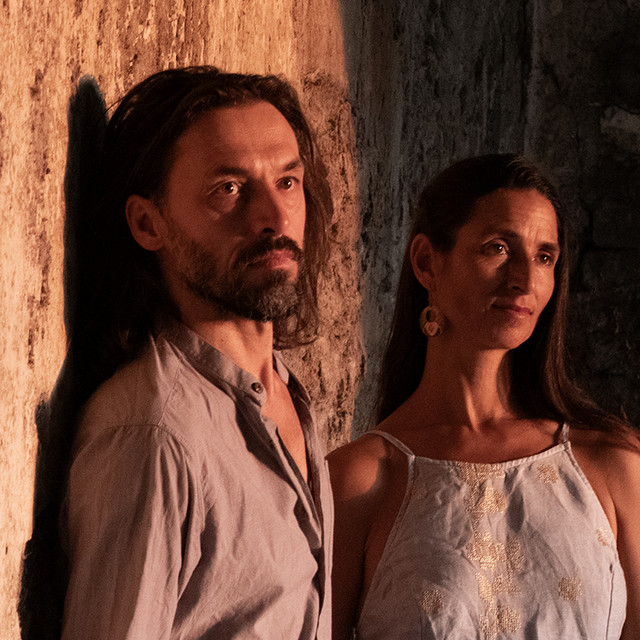
Que Quede Escrito is a kirtan song by Mirabai Ceiba that explores the paradox of physical separation and spiritual unity. Written years ago during a long-distance relationship marked by months apart and months together, the song resurfaces in their album The Quiet Hour as a vessel for understanding collective human experience—particularly the realization that distance cannot sever what connects us at the soul level. The piece insists that in the domain of souls, there is no true separation, only the illusion of it.
What is the core message of "Que Quede Escrito"?
The song's title translates to "Let my heart here be written." This phrasing sets the tone for what Mirabai Ceiba explores: the act of inscribing something permanent into being through sound and intention. The opening refrain—"Que quede escrito aquí mi corazón / Que lo lea el alma / Que las escrituras canten" (Let my heart here be written / Let the soul read it / Let the scriptures sing)—frames the voice not as an individual ego speaking, but as a conduit for something that exists beyond personal emotion. The speaker's heart becomes a text; the soul becomes the reader; and the scriptures themselves are invited to sing rather than merely be recited.
This structure is deliberate. Rather than declaring "my heart is written," the song asks for it to be written. The invocation creates space for participation—from the listener, from consciousness itself. In this framing, the song becomes a ritual utterance, a plea to have one's deepest truth registered not just in human memory but in the fabric of existence.
How does the song address the theme of distance and separation?
The central revelation arrives in the song's refrain: "No hay distancia en este mundo de almas / No hay separación / En este preciso instante" (There is no distance in this world of souls / There is no separation / In this very moment). This is not poetic metaphor alone; it articulates a specific teaching about the nature of consciousness and relationality.
Mirabai Ceiba wrote this song during a phase in their relationship marked by stark physical separation: months meeting in Germany, months apart, months in Mexico, and so on. The conditions were what they describe as "all or nothing"—intense presence followed by absence. Rather than eroding the connection, these cycles deepened it, creating space for poetry and song. The geographical punctuation forced a confrontation with the question: what persists when the body is not present?
The answer embedded in the song is that separation at the physical level is not separation at all. The song does not deny distance; it reframes it. Distance is real for the body, but for souls—for the witnessing consciousness within each being—there is no such thing. The "world of souls" exists in a different order of reality than the geography that keeps bodies apart. By anchoring awareness in that domain, the song suggests, the pain of separation becomes transparent to a deeper truth.
Why does this song resurface for "The Quiet Hour" album?
The most significant aspect of Que Quede Escrito's resurgence is its timing. Written during Mirabai Ceiba's personal experience of distance, the song has gained unexpected relevance as a mirror for collective human experience. The album The Quiet Hour was created in a context of global separation—what Mirabai Ceiba identifies as humanity going through a moment where "what seems important is to realize that even when there is physical separation, there is nothing that can really separate us from each other."
This is an explicit reference to the pandemic and its enforced isolations. But the teaching goes beyond pandemic commentary. It speaks to a fundamental truth about human consciousness: that separation is always partially illusory, that bodies can be distant while souls remain unified, and that in moments of genuine clarity, this unity is felt as present and real.
By repositioning a song born from personal longing as a statement about collective resilience, Mirabai Ceiba invites listeners to shift their own relationship to separation. The song becomes less about romantic distance and more about the metaphysical fact that consciousness—the core of what we actually are—cannot be sundered by external circumstance.
What is the spiritual framework underlying the song?
The language of the song draws from a non-dual understanding of reality: the recognition that beneath apparent multiplicity and separation lies an underlying unity. The emphasis on "this world of souls" suggests a conscious realm that operates according to different laws than the physical world. In that realm, distance collapses. Separation dissolves. What remains is presence—"en este preciso instante" (in this very moment).
The invocation to "let the scriptures sing" is particularly significant. Rather than treating sacred texts as fixed, frozen, or merely informational, the song asks that they become alive, animated, singing. This reflects a view of tradition as living rather than historical—as something that breathes and responds to present conditions. The scriptures, properly understood, are not museum pieces documenting old truth; they are living vessels that continue to speak to new circumstances.
Similarly, asking that "the soul read" the inscribed heart suggests that understanding operates at a level deeper than intellectual comprehension. The soul, in this framework, is the knowing faculty that perceives truth directly, without mediation by thought. When the soul reads, it recognizes itself in what is written.
How do the visual elements of the music video reinforce the song's message?
The video was filmed in two distinct locations: Sian Ka'an, Mexico, and Fanore Beach, Ireland. This geographic separation mirrors the song's engagement with distance. Rather than presenting a unified location, the video embodies the physical separation it sings about. Yet through the continuity of editing and the presence of the singers' voices—unified across both locations—the visual medium demonstrates the very teaching the song articulates: bodies in different places, yet seamlessly connected through the medium of voice and presence.
The choice of natural settings—a biosphere reserve in Mexico and a beach in Ireland—grounds the song in the earth itself. These are not arbitrary backdrops but places where the boundary between land, sea, and sky is palpable. By filming in such liminal spaces, the video suggests that the dissolution of barriers between separated places is already written into nature. In the tidal zones and horizons where elements meet, the artificial nature of human separation becomes visible.
What makes this song relevant beyond spiritual communities?
On the surface, Que Quede Escrito can be encountered as a beautiful love song about longing and connection across distance. But its utility extends into anyone's direct experience of separation—whether that separation is romantic, geographical, temporal, or existential. The song speaks to the universal human experience of missing someone, of feeling incomplete in their absence, and of seeking reassurance that distance has not truly broken what matters.
The reframing offered—that true separation is impossible between souls—is not presented as dogma but as lived experience made audible. Mirabai Ceiba did not arrive at this teaching through abstract philosophy; they arrived at it through the raw material of months apart and months together, through the real test of whether love and connection can survive spatial division.
What emerges is a song that bridges the personal and the universal: particular enough to honor genuine longing, vast enough to encompass the shared human recognition that separation is never complete, that souls touch across any distance, and that the most important truths are written not in ink but in the very substance of being.
Where to go from here
To experience Que Quede Escrito fully, listen to the track within The Quiet Hour album (available on all major platforms via spiritvoyage.com/music/the-quiet-hour/). The lyrics in Spanish and their English translation invite contemplation of the teaching embedded in each phrase. Consider the song as a practice: when separation—physical, emotional, or spiritual—arises in your life, return to the refrain and test its truth against your direct experience. Is there truly a level at which you remain connected to what you love, even across distance? Can you access that place of "no separation"? The song invites you into your own discovery rather than asking belief.


