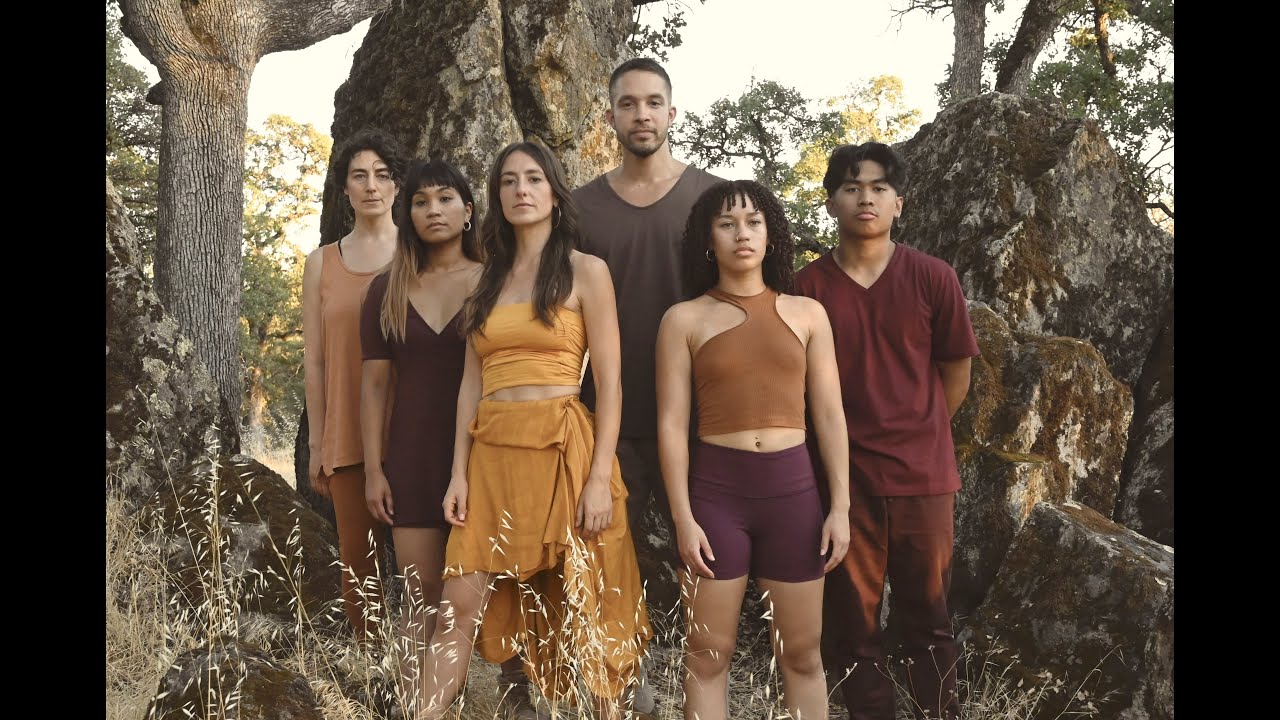
In "Whispers," performed live in Northern California's forests, Ayla Nereo offers a devotional song that treats the voice as a sacred channel for receiving wisdom from the natural world. The piece moves through invocation of trees and water, acknowledges ecological grief, and culminates in a collective call to reciprocal care—suggesting that opening one's ears and body to nature's messages is inseparable from a commitment to tend to what sustains us.
What is "Whispers" about?
"Whispers" is a devotional composition structured as a prayer-song to the living world, particularly to the trees and waters of forests. The song operates on multiple levels simultaneously: as a personal practice of opening the body to listen, as a lament for damaged ecosystems, and as a collective invitation to reciprocal relationship with nature. Rather than explaining nature's value in abstract terms, Nereo embeds the teaching within the lived experience of singing itself—the act of opening one's voice becomes the practice of opening one's capacity to receive.
The opening invocation addresses pine trees directly: "I am calling to you / I am singing to you." This establishes the song's first principle: that singing is a mode of address, a way of speaking toward the more-than-human world. The lyrics immediately personify the forest as an entity capable of response, listening, and offering: "you open these vessels to receive your whispers / tender breath keepers / givers of life to these lungs."
How does the song frame the voice as a spiritual practice?
Nereo presents the voice not as a tool for self-expression but as a threshold—a place where the boundary between the human body and the natural world becomes permeable. The recurring refrain, "may I open my ears and surrender / what will you tell me," positions listening as the primary spiritual work. The voice, in this frame, is the instrument through which listening becomes embodied.
The phrase "open these vessels to receive your whispers" appears throughout the song, emphasizing that the body itself is a receptacle. This echoes indigenous and contemplative traditions in which the human body is not a separate observer of nature but a vessel within nature—made of the same water, breath, and elements. Nereo's repeated invitations to "open" and "surrender" suggest that spiritual communion requires a deliberate unclenching, a release of the ego's desire to know or control what will be received.
The song suggests that the voice has a particular role in this opening. By singing, by using the breath to create sound, the singer directly engages the lungs and diaphragm—the organs through which life enters the body. Singing, in this context, is both literally and symbolically an act of breathing *with* the world, of synchronizing one's breath with the breath of the forest.
What ecological awareness does the song carry?
Midway through the performance, the song's tone shifts from invocation to grief. Nereo sings: "there are rivers / going / dried up made of pain / drought / rain can / be used for rain / but if we cut them go away." The language becomes fragmentary here, almost overwhelmed—reflecting the difficulty of speaking about ecological damage. The song doesn't retreat into abstraction; instead, it names specific losses: dried rivers, droughts, and the consequences of cutting trees.
Importantly, the song positions this grief not as a reason for despair but as a call to attention. By acknowledging that "rivers go away" if we cut them, Nereo is naming cause and effect, human responsibility and natural consequence. The song doesn't offer false reassurance; it insists that listening to nature's whispers requires also hearing its cries of loss.
What is the song's teaching on reciprocity?
As the song builds toward its conclusion, Nereo introduces a principle of reciprocal restoration: "for every one of us / you can / it by planting another of the same / as the kind / you give / every ending beginning / choose." The text is fragmented, but the teaching is clear: for every tree that ends, a beginning can be planted. For every act of extraction, there can be an act of renewal.
This is not presented as optional or aspirational. The word "choose" appears as both an invitation and a subtle imperative—you *can* choose this. The song suggests that reciprocity is available to us at every moment, at every ending, if we consciously elect it. This extends beyond trees: the principle applies to "every one of us"—every being that receives life from the world has the capacity and responsibility to give life back.
In the final section, the song moves from singular ("may I") to collective ("may we"): "how can we tend to the ones who pour life through these love." The shift signals a move from personal spiritual practice to communal responsibility. The song proposes that opening to nature's whispers is not complete without a commitment to tend to those beings—human and more-than-human—who sustain us.
How does the forest setting shape the performance?
The song was filmed live among the forests of Northern California, a choice that is not merely scenic but integral to the work's meaning. Nereo is not singing *about* forests from a distance; she is singing *within* them, her voice entering into spatial and acoustic relationship with the very beings she addresses. The trees themselves become part of the choir, their acoustic presence altering how the song is heard.
This embodied, site-specific approach suggests that devotional singing is not separate from place. The song cannot be fully understood apart from the forest context—just as, Nereo might argue, any spiritual practice of listening to nature cannot be abstracted from actual relationship with actual places.
Where to go from here
To deepen this practice, Nereo offers further guidance through her course "Meeting the Muse," a free 5-day journey in vocal and creative liberation, and "Empowered Voice," a more extensive exploration of voice as a tool for personal and collective power. These resources suggest that "Whispers" is not a finished teaching but an invitation—a threshold into deeper work with voice, listening, and the relationship between human expression and natural reciprocity. The song itself remains the foundational practice: open the body, attune the ears, and ask: what does the world want to tell me, and what do I choose to give in return?