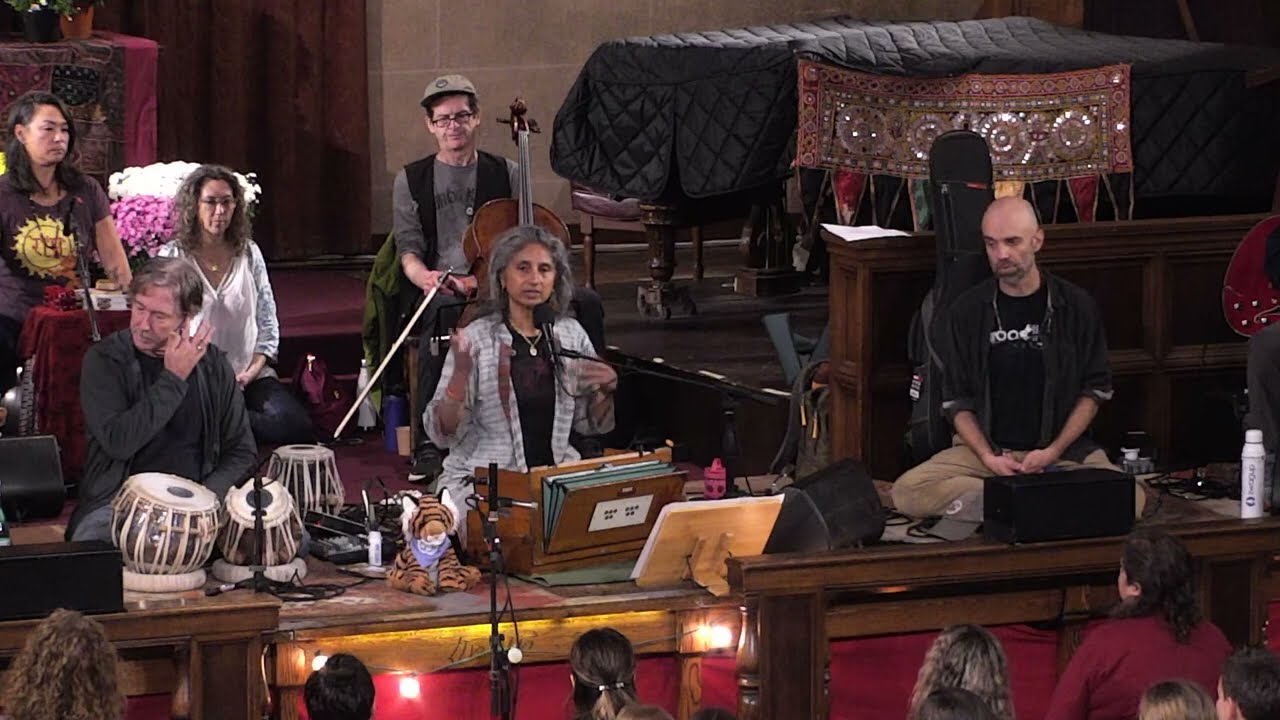
Pema Sukhmani's "In the Shallows" is a kirtan song that uses the metaphor of shallow water—where reflection is impossible and steps are missing—to articulate ecological devastation and humanity's loss of planetary consciousness. The song moves from visual observation of environmental harm (through albatross footage and seed-to-plant imagery) to an urgent collective call: notice what we are doing, notice what we are harming, and rebuild our minds together to raise the planet.
What Does "In the Shallows" Actually Mean?
The title and central image anchor the song's deeper meaning. Shallows are places where reflection cannot occur—water too thin to mirror back what stands above it. In this song, the shallows function as both literal ecological space and metaphor for human consciousness cut off from awareness of its own impact.
Sukhmani sings: "In the shallows there is missing a step / There is no reflection in the shallows." This doubled negation—missing steps and absent reflection—suggests a kind of disorientation. We are walking through spaces we have damaged without seeing ourselves, without recognizing our footprints. The shallows become the space of unconscious destruction: we move through them, but we cannot see what we are.
The opening verses establish this loneliness: "In the shallows where I walk alone / The beach side alone." This solitude is not peaceful meditation; it is isolation born of disconnection. The speaker walks in a damaged ecosystem, alone with the consequences of collective harm.
How Does the Song Name Environmental Destruction?
The song names what it observes directly. The most explicit lines arrive in the central movement: "The shallows are soon giving up / For all the things we have done to them." Here, the shallows—standing in for coastal ecosystems, oceans, and the biosphere itself—are depicted as surrendering. They are exhausted by human harm.
The paired phrases that follow intensify this recognition: "We are firing, we are tiring / To all the places we have been." The homophone play between "firing" and "tiring" collapses destruction into fatigue. We are both actively destroying (firing) and burning out the places we visit. The repetition signals compulsion—a habitual pattern of harm.
The song's visual content, filmed in Corfu, Greece, and accompanied by projected footage from Chris Jordan's documentary Albatross and Daniel Csobot's seed-to-plant time-lapse, reinforces this theme. The albatross footage—likely depicting the film's central image of plastic-filled bird corpses—makes explicit what the lyrics suggest: oceans are filling with human waste. The seed-to-plant footage, by contrast, shows natural potential and regeneration, highlighting the gap between what the planet can produce and what we destroy.
What Is the Call to Collective Awareness?
At the song's turning point, the address shifts from observation to demand: "Now notice us, notice what we are doing / Now notice us, notice what we are harming." This repeated plea is not gentle. It is insistent, almost aggressive in its directness. Notice—pay attention. See what we are doing. Acknowledge what we are harming.
This is a call for collective accountability. The use of "us" implicates the listener in the action. We are all doing this. We are all harming. There is no distance between singer and listener, between observer and participant. The song refuses the comfort of pointing fingers at distant "others" responsible for environmental destruction.
What follows is equally stark: "There is a hidden world behind you, / Behind your back." This suggests that awareness itself has turned away from us. The living world continues behind our backs—we have become inattentive to it, or worse, we actively ignore it while it suffers.
How Does the Song Frame Collective Loss?
One of the most profound moments arrives in the bridge: "Now help yourself, I am lost / You are lost, everyone's lost / We have lost who the planet was." This stanza moves through stages of recognition, from individual confusion to collective disorientation to a loss so deep it erases identity itself. We have lost who the planet was—not just what it provided, but its essential being, its character, its aliveness as known to us.
The repetition of "we are firing, we are tiring / to all the places we've been" underscores that this is not new. We have done this for a long time. The places "we have been" are places we have damaged through our very presence. Tourism, extraction, habitation, consumption—all the ways human beings move through the world—leave trails of exhaustion.
What Is the Song's Call to Action?
Rather than despair, the song pivots toward agency: "It's time to raise the planet / Let's build our minds together, let's start right now." The imperative is clear: collective consciousness must be rebuilt. Not individual enlightenment or personal transformation, but shared mental and emotional reconstruction.
"Let's build our minds together" suggests that the planetary crisis is fundamentally a crisis of collective cognition. We think separately, in isolation, pursuing individual interests. The song calls for a different mode of thinking—interconnected, shared, aligned with planetary need rather than individual gain.
"Let's start right now" refuses delay. There is no time for gradual awakening or incremental change. The urgency is absolute. The shallows are giving up. The moment is now.
What Does the Repeated Return to "In the Shallows" Accomplish?
The song returns to its opening image: "In the shallows there is missing a step / There is no reflection in the shallows." This return is not comfort or resolution. It is a reminder. Even after the call to action, after the plea for collective awareness, we remain in the shallows. The water is still too shallow for reflection. We are still walking without seeing ourselves.
This cyclical structure suggests that the song is not offering a narrative arc toward salvation. Instead, it holds the tension: we know what we must do (notice, build our minds together, raise the planet), yet we remain in the condition that prevents us from seeing what we are doing. The song does not resolve this tension; it insists that we live within it, awake to the paradox of knowing and not-knowing simultaneously.
Where to Go From Here
Listen to "In the Shallows" not as a finished meditation but as an ongoing invitation. The song asks: What am I not noticing about my impact on the places I inhabit? Where am I walking alone, disconnected from the consequences of my presence? What would it mean to rebuild my mind in connection with others, oriented toward planetary healing rather than individual extraction?
The kirtan form—call and response, repetition, musical meditation—invites listeners to enter the song's consciousness rather than observe it from outside. Singing or listening deeply to the lyrics creates a practice of noticing, of allowing the song's ecological awareness to move through your own awareness. In this way, the song itself becomes a tool for the collective mind-building it calls for.