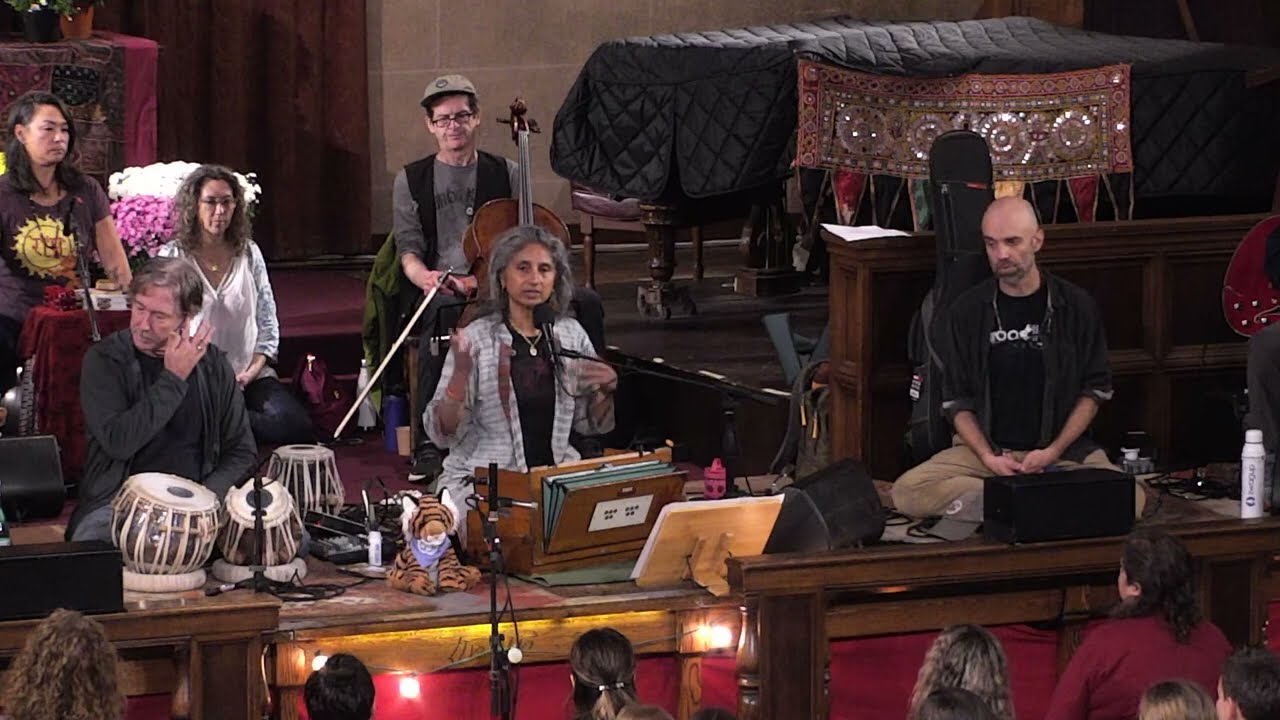
At Omega's 2009 Ecstatic Chant retreat, three accomplished kirtan leaders—Jai Uttal, Krishna Das, and Shyam Das—gather to sing together and model a crucial aspect of devotional practice often overlooked in formal settings: uninhibited joy, humor, and genuine camaraderie. Rather than performing for an audience, they demonstrate that kirtan at its heart is about celebration, play, and the freedom to be fully human while invoking the divine. The session reveals that mastery in chanting traditions is not about perfection but about showing up authentically, making mistakes, joking, and finding spiritual nourishment in shared laughter and song.
What Makes Chanting Genuinely Ecstatic?
Ecstasy in kirtan is often imagined as an elevated, transcendent state—meditative, serious, removed from everyday life. But the session at Omega reframes ecstasy as something far simpler and more accessible: the joy of being together, singing together, and allowing yourself to be playful and present. Jai Uttal opens by reflecting on the shared experience: "What a great time we've all had here." This is not a metaphysical claim but a lived acknowledgment that the substance of the practice is the gathering itself, the voices interweaving, the celebration of community.
The teachers make clear that ecstasy emerges when participants stop trying to achieve a spiritual state and instead surrender to the natural pleasure of sound, rhythm, and togetherness. One of the recurring themes is gratitude for the privilege of singing: "I'm thankful to be among the crowd in the song in this celebration." This gratitude is not performative—it is expressed while actively singing, embedded in the act itself. The implication is that if you are present in the singing, if you show up with genuine appreciation for the people around you and the practice itself, ecstasy is already happening.
How Does Humor Deepen the Practice?
A striking element of this session is the consistent presence of humor, self-awareness, and gentle teasing among the teachers. Rather than being at odds with spiritual practice, humor appears to be integral to how experienced chanters embody the work. When one of the teachers offers a quip, another laughs and says, "I will not take that personally"—a simple statement that carries profound teaching. To not take things personally in a shared space means you are free to be yourself, to joke, to make mistakes, and to know that everyone around you is also freed from the burden of needing to be perfect or "properly spiritual."
This dynamic invites participants to relax. In many spiritual contexts, there is an implicit pressure to achieve the "right" state, to look or sound a certain way, to fit into an ideal. But when the teachers are joking with each other—the core message is: you do not have to earn your place here through solemnity or performance. Your humanity is welcome. The playfulness is not a distraction from the practice; it is an essential protection against spiritual bypassing, against the ego claiming ownership of the experience.
What Does It Mean to "Play" in Spiritual Song?
One of the most direct teachings comes near the middle of the session: "While everyone else cry, I will play. I will play. I will sing." This statement is worth sitting with. The teacher is not dismissing tears or depth—those are part of kirtan too. Rather, he is asserting the right to express a different mood, a different approach on a given day or moment. Some days, chanting opens you to grief or release. Other days, it opens you to laughter, lightness, and delight. Both are valid. Both are the practice.
This goes against the implicit hierarchy in many spiritual traditions, where states associated with intensity, tears, or transcendence are valued over joy and levity. The teachers here are modeling a more mature, integrated approach: the practice is large enough to hold all human emotional responses. You bring your whole self—your sense of humor, your capacity for play, your genuine delight in the company of others—and that is not a dilution of the work but an expression of it.
Why Does Singing Together Create Such a Distinct Bond?
The session repeatedly emphasizes the collective nature of the practice. "You have sung so much at the right times all every day"—there is an appreciation that every voice in the room has contributed to the whole, that consistency and presence over time build something real. This is not about individual achievement but about showing up repeatedly, offering your voice, and trusting that the collective sound is stronger because of your participation.
The repetition of certain mantras and sounds throughout the session—the sustained chanting of "Hallelujah" and other sacred syllables—also speaks to how kirtan works. The mantra is not meant to be sung perfectly; it is meant to be sung together, again and again, until the distinction between your voice and the voices of others begins to dissolve. In that dissolution, something unexpected happens: you feel less lonely, less separate. You recognize that you are part of something larger, not through intellectual understanding but through direct experience of harmonizing with others.
How Do Master Teachers Model Authenticity?
One of the implicit teachings of this video is how much power there is in simply being authentic at your level of attainment. These are not new teachers or uncertain practitioners. They are masters of the form, with decades of experience. Yet they show up to this session without pretense. They joke, they laugh, they acknowledge the effort of singing ("I don't know what more I can say"), they reference lunch and everyday life. This grounds the practice in the real world, in real bodies, in real time.
For anyone new to chanting or to spiritual practice in general, this modeling is invaluable. You do not need to wait until you are "enlightened" or perfectly disciplined to join kirtan. You do not need to pretend to feel states you do not feel or to be someone other than who you are. The masters themselves are showing that authenticity—showing up as you are, with your personality intact, with your humor available—is what makes the practice alive and contagious to others.
Where to go from here
If you are drawn to kirtan or chanting practice, the primary invitation from this session is simple: seek out a community that values genuine joy and camaraderie alongside devotion. Look for teachers who are willing to be human, to laugh, and to celebrate the people in the room rather than performing spirituality. If you are already practicing, notice whether you have permission to bring your whole self—your playfulness, your humor, your lightness—or whether you have internalized a version of the practice that requires you to be more serious, more elevated, more "spiritual" than you naturally are. The teachers here suggest that the most powerful kirtan happens when you let that requirement go. Sing loudly. Laugh. Show up as you are. The ecstasy is already in the room.