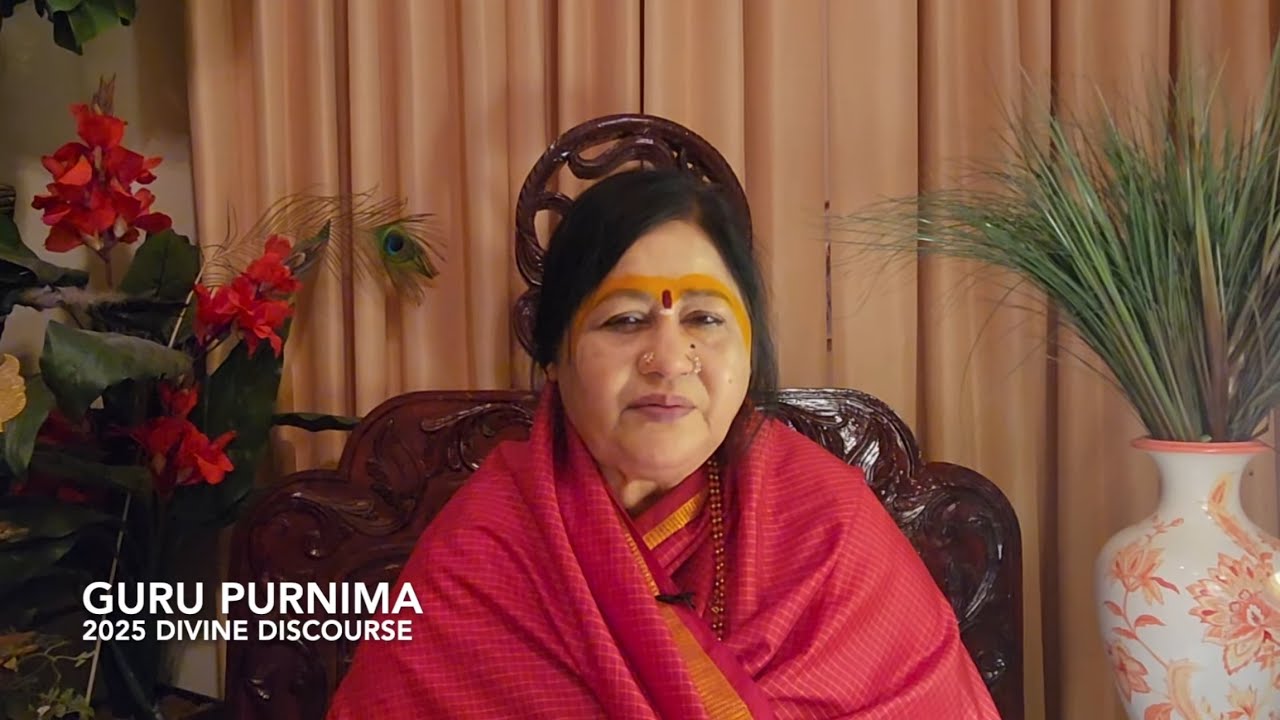
Sri Karunamayi offers a deep discourse on Sri Lalita Sahasranama, the 1,000 sacred names of the Divine Mother Lalita Devi, exploring the cosmological significance of each name, the structure of Sri Chakra as the seat of the Divine Mother, and the transformative power of chanting this stotra. The teaching emphasizes how regular chanting of these names dissolves delusion, purifies the subtle body, and facilitates direct experience of Brahman consciousness.
What is Sri Lalita Sahasranama?
Sri Lalita Sahasranama is a Sanskrit hymn of one thousand names honoring Lalita Devi, the Divine Mother in her transcendent form. Each of the thousand names encodes specific qualities, cosmic functions, and aspects of divine consciousness. Sri Karunamayi explains that these names are not mere titles but direct expressions of how the Divine Mother manifests in creation, consciousness, and the subtle dimensions of being.
Unlike devotional poetry that describes the Goddess in flowery language, Sahasranama functions as a knowledge-carrying text. Each name contains encoded wisdom about the nature of reality, the structure of consciousness, and the mechanisms through which divine energy sustains all existence. Chanting these names is therefore an act of both worship and direct knowledge transmission.
Why Does Each Name Matter in the Sahasranama?
Sri Karunamayi emphasizes that every single name in the Sahasranama addresses a specific aspect of divine function. Some names describe the Mother as the creator and sustainer of all worlds (Jagajjanani—Mother of the Universe). Others describe her as consciousness itself (Chaitanyaswarupini—the embodiment of pure awareness). Still others name her according to her seat of power—Sri Chakra—or her role in dissolving ignorance and granting liberation.
The significance lies in the principle that whatever dimension of reality or consciousness you wish to understand or transform, invoking the appropriate name of Lalita Devi activates that frequency within your own being. The names are invocations that align the devotee's consciousness with specific divine frequencies. This is why Sri Karunamayi stresses that understanding the meaning of each name deepens the transformative power of chanting.
What is Sri Chakra and Its Role in the Sahasranama?
Central to understanding the Sahasranama is the concept of Sri Chakra—the cosmic diagram of interlocking triangles that represents the structure of creation and consciousness. Sri Karunamayi explains that Sri Chakra is not merely a geometric form but the actual throne (simhasana) upon which Lalita Devi sits. The Sri Chakra contains nine concentric triangles surrounding a central bindu (point), representing the emanation of all existence from the singular consciousness of the Divine Mother.
The upward-pointing triangles symbolize the masculine principle (Shiva consciousness), while the downward-pointing triangles symbolize the feminine principle (Shakti). Their interlocking creates the entire cosmos. Many of the names in the Sahasranama specifically reference the Sri Chakra and its powers. By chanting these names, the devotee is invoking the chakra's transformative power within their own subtle body, activating the dormant divine energy centered at the seat of consciousness.
How Does Chanting Sahasranama Affect the Mind and Subtle Body?
Sri Karunamayi teaches that the human being is not only a physical body but a multilayered structure extending through subtle dimensions. Within this subtle anatomy, divine shakti (power) lies dormant. The practice of chanting Sahasranama directly activates this dormant power. As each name is recited with awareness of its meaning, the subtle channels (nadis) are purified, and the mind is gradually drawn inward toward its source.
The dissolution of mental delusion (bhrama) is a primary benefit. The discursive mind tends to create false distinctions between self and other, sacred and mundane, eternal and temporal. Through repeated chanting of names that proclaim the nondual nature of the Mother—that she is the sole reality, the consciousness in all beings, beyond form yet manifesting as all forms—the mind's tendency toward fragmentation gradually dissolves. The practitioner moves from seeing the world as separate objects to recognizing it as a unified expression of divine consciousness.
What Are the Specific Benefits of Regular Sahasranama Practice?
Sri Karunamayi outlines several practical outcomes of sustained Sahasranama chanting. First, the practice purifies the inner space of the heart and mind. Negative impressions (samskaras) stored in the subtle body—accumulated patterns of fear, anger, attachment, aversion—begin to surface and dissolve when exposed to the frequency of the Divine Mother's names. This process can sometimes feel uncomfortable, as old trauma and conditioned patterns rise to consciousness before they release.
Second, chanting opens the channels of grace. The devotee's heart becomes a vessel for divine compassion to flow through. This does not mean that the external world immediately transforms—rather, the devotee's relationship with external circumstances transforms. Events that once provoked suffering are seen with clarity and equanimity. The practitioner experiences freedom within all circumstances.
Third, the practice facilitates the experience of Brahman—the ultimate reality beyond all names and forms. This may seem paradoxical: how do finite names lead to the formless infinite? Sri Karunamayi explains that the thousand names, when fully internalized, point beyond themselves to their source—the nameless, formless consciousness from which all names and forms arise. In this way, the Sahasranama functions as a ladder that is climbed and then transcended.
How Should One Approach Chanting Sahasranama?
Sri Karunamayi emphasizes that the method of practice matters. Simply reciting words mechanically, without attention to their meaning or without devotional sincerity, produces minimal benefit. The ideal approach is to:
- Understand the meaning: Before chanting, study the meanings of the names so that when you recite them, your mind engages with their significance rather than merely pronouncing sounds.
- Cultivate genuine devotion: Approach the practice not as a transaction or a means to gain personal benefits, but as an act of love and surrender to the Divine Mother. Let the names awaken your heart's natural love for the sacred.
- Maintain consistency: A daily practice, even if brief, produces more transformation than occasional marathon sessions. The subtle channels of the body respond to steady, patient effort.
- Meditate on what arises: As you chant, various thoughts, emotions, and subtle experiences may surface. Rather than dismissing them, observe them with witnessing awareness. These are the mind and body releasing stored patterns.
What Is the Relationship Between the Sahasranama and Direct Experience?
A central theme in Sri Karunamayi's teaching is that ultimate spiritual realization is not a matter of mere intellectual knowledge but of direct inner experience (sakshatkara). The Sahasranama serves as a gateway to such experience. Each name is like a key that unlocks a particular chamber within the inner temple of consciousness.
Sri Karunamayi stresses that the Sahasranama was composed not as abstract theology but as a practical technology of consciousness. The ancient seers (rishis) who compiled these thousand names did so on the basis of direct yogic insight into how the Divine Mother actually functions in creation. When you chant these names with focus and sincerity, you are not merely repeating someone else's words—you are activating your own latent capacity to recognize and commune with the divine presence that pervades all existence.
The promise, then, is not metaphorical. Sri Karunamayi indicates that sustained practice can lead to genuine mystical experiences: visions of divine light, the spontaneous opening of spiritual centers (chakras), the dissolution of the sense of separation from the infinite, and ultimately the unshakeable recognition of oneself as nondifferent from Brahman consciousness.
Where to Go From Here
Those drawn to this teaching may begin by obtaining a translation of the Sri Lalita Sahasranama with commentary. Study the first fifty names thoroughly, understanding their meanings and their significance within the overall cosmological framework. Then commit to chanting these fifty names daily for forty days, paying attention to shifts in your inner experience. As the practice deepens, gradually expand to longer sections of the full thousand names. Consider seeking out a guru or spiritual community where the teachings are transmitted directly, as such transmission carries a grace beyond written words. Most importantly, approach the practice with sincere devotion and patience—the fruit of Sahasranama chanting cannot be forced but unfolds naturally as the heart and mind are gradually purified through contact with these sacred names.